
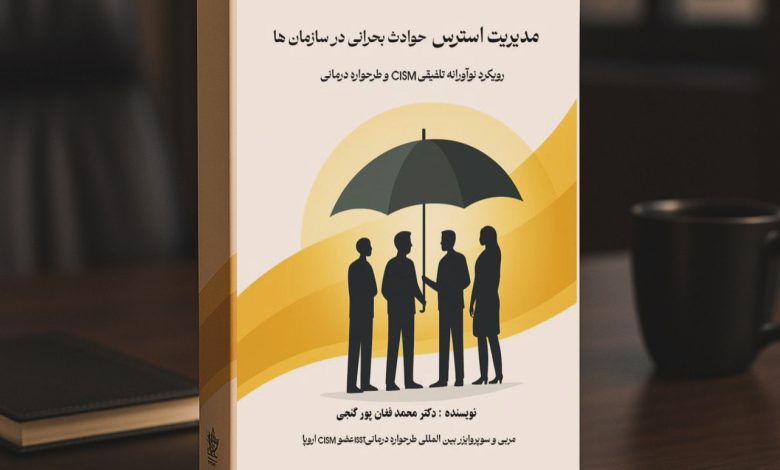
Exclusive interview with Dr. Mohammad Faghanpour Ganji about the book "Critical Incident Stress Management in Organizations"
**Book:** Critical Incident Stress Management in Organizations
**Subtitle:** An Integrative Approach Combining CISM and Schema Therapy
**Author:** Dr. Mohammad Faghanpour Ganji
**International Schema Therapy Trainer & Supervisor (ISST)**
**Member of CISM Europe**
**Contact:** Available to the press upon request
**Q1: Please introduce the book you have authored. What is its main focus?**
“The Management of Critical Incident Stress in Organizations” is the first comprehensive book in Iran integrating *Critical Incident Stress Management (CISM)* and *Schema Therapy (ST)*. It explores the psychological and organizational dimensions of crises, building a bridge between psychotherapy and leadership practice.
**Q2: What motivated you to write this book?**
Most crisis management interventions in organizations focus solely on logistics and neglect the human and emotional dimensions. Conversely, therapists often lack familiarity with organizational realities. This book aims to create a shared language between managers, psychologists, and crisis responders through the Schema–CISM model.
**Q3: Who is the target audience of the book?**
The book addresses three primary audiences: organizational leaders, occupational psychologists, and crisis management professionals. However, its accessible language also makes it suitable for general readers interested in workplace resilience and mental health.
**Q4: What are the main conceptual pillars of the book?**
1. Introducing the CISM framework for organizational settings.
2. Identifying maladaptive schemas triggered during crises.
3. Presenting the integrative Schema–CISM model.
4. Offering practical tools and intervention templates for leaders and organizational psychologists.
**Q5: How significant is this book for the Iranian academic and professional context?**
In Iran, literature on organizational stress is often limited to behavioral perspectives. This book introduces a psychotherapy-based approach, addressing a critical gap between emotional reality and managerial response in times of crisis.
**Q6: How up-to-date and evidence-based are the book’s references?**
The content reflects the latest research from ISST and ICISF up to 2025, integrating global findings with real-world experience from Iranian and European organizational projects.
**Q7: What has been the response from readers and professionals?**
Feedback has been overwhelmingly positive. Experts describe it as a pioneering contribution that deepens understanding of crisis-related stress in workplaces and provides actionable solutions. Some universities have already included it as a recommended reference for industrial and organizational psychology courses.
**Final Note:**
The core message of the book is that organizational resilience is not merely a managerial achievement—it is a human process rooted in empathy, awareness, and emotional growth within crisis. This work aspires to inspire organizations to become both effective and emotionally intelligent.
