
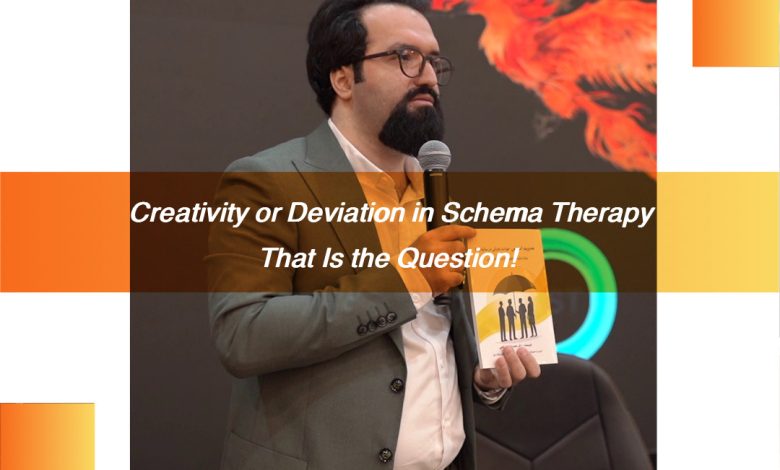
Creativity or Deviation in Schema Therapy — That Is the Question!
In recent years, Schema Therapy has experienced unprecedented growth in Iran and around the world. This expansion has created remarkable scientific opportunities—but it has also led to the emergence of trends that sometimes present themselves as “innovation” or “theorizing,” while in fact drifting away from scientific standards.
In this special interview with SchemaNews, **Dr. Mohammad Faghanpour—ISST-certified international trainer and supervisor—clarifies the boundary between “creativity” and “deviation,” integrating key insights from his keynote lecture on World Schema Therapy Day, titled “The Phoenix of Joy Rising from the Fire of Crisis.”
Full Interview
Question 1 | Why has the issue of “creativity vs. deviation” become so crucial in Schema Therapy today?
Dr. Faghanpour:
Because Schema Therapy is a research-based, highly structured model established over decades of empirical studies, clinical experience, and international scientific collaboration.
Yet today, as the popularity of Schema Therapy grows, we are witnessing two parallel phenomena:
Necessary and valuable scientific innovation, and
Non-scientific deviation, which distorts the model
If the boundary between these two is not clearly defined, Schema Therapy can gradually devolve into a set of personal interpretations, cultural judgments, or improvised models.
This is precisely what I refer to as a “crisis of identity in Schema Therapy.”
Question 2 | Some claim that adding new schemas or new modes is a form of innovation. What is your opinion?
Dr. Faghanpour:
Innovation is meaningful only when it meets scientific requirements:
A clear operational definition
Testability and replicability
Integration with existing literature, or a well-argued scientific critique
Empirical evidence
Peer review and ISST scientific evaluation
But what we see in certain circles includes:
Creating schemas based on cultural or value-based judgments
Inventing new modes without theoretical grounding
Redefining coping styles into new three-part or multi-layer models
Turning personal clinical impressions into “theory”
These are not innovations—
They are deviations.
**Creativity means adding to the model;
Deviation means distorting it.**
Question 3 | In your keynote lecture, you emphasized the metaphor “The Phoenix of Joy Rising from the Fire of Crisis.” How does this relate to Schema Therapy today?
Dr. Faghanpour:
The metaphor highlights that every major transformation is born from crisis—if the crisis is understood correctly.
Today, Schema Therapy faces two intertwined crises:
1. A Scientific Crisis
Marked by superficial interpretations, technique-driven practice, and the spread of eclectic shortcuts.
2. A Professional Identity Crisis
Where individuals with no formal training, no personal therapy, and no clinical supervision begin practicing psychotherapy.
In my keynote, I referred to this phenomenon as:
“Wild Psychoanalysis”
It:
Damages the therapeutic relationship
Confuses the client
Distorts the model
And, most importantly, mislabels itself as “Schema Therapy”
When in reality, it has no connection to ST.
Question 4 | What is WILD and how does it create deviation?
Dr. Faghanpour:
WILD refers to:
Superficial psychology
Technique-centered shortcuts
Speed over depth
Celebrity-style teaching
Attractive but shallow methods
It is a form of entertainment psychology, not clinical science.
When WILD enters Schema Therapy:
Technique replaces process
Superficial interpretation replaces deep emotional work
And therapists begin making dangerous assumptions without personal therapy or supervision
This is exactly the environment in which deviations flourish.
Question 5 | You explained in your lecture how the ISST professional pathway prevents deviation. How does it work?
Dr. Faghanpour:
The ISST pathway is designed as a scientific safety system.
Its structure includes:
Formal certified training
Extensive supervision
Recorded case submissions
Clinical experience with complex cases
Development of supervisory skills
Ability to teach the model professionally
This ensures that the therapist:
Understands the model deeply
Does not replace theory with personal interpretation
And can navigate complex cases without creating distortions
The length and rigor of the pathway
is exactly what prevents dangerous shortcuts.
Question 6 | You often speak of the four pillars of scientific clinical practice. How do they prevent deviation?
1. Scientific Education
→ prevents rootless additions
2. Personal Therapy
→ prevents therapist’s schemas from shaping the model
3. Professional Supervision
→ prevents technical drift
4. The repeated use of “I don’t know”
→ prevents dangerous overconfidence
“I don’t know” is not a weakness;
It is the foundation of professional integrity.
Deviation always begins when a therapist says:
“I know—even without research.”
Question 7 | What is your message for the Schema Therapy community?
Dr. Faghanpour:
We are at a critical moment.
Schema Therapy is now a global clinical language.
Iran plays an important role in this growth—but only if we remain:
Loyal to scientific research
Cautious of emotional shortcuts
Committed to supervision and training
And oriented toward scientific—not personal—innovation
As I said in my keynote:
**“Innovation is the scientific response to crisis;
Deviation is the emotional reaction to crisis.”**
Final Summary for SchemaNews.org
This interview provides a clear perspective on the current challenges and opportunities within Schema Therapy. By integrating the key themes of the “Phoenix of Joy” keynote with an analytical view of the contemporary ST landscape, it offers a comprehensive, compelling, and scientifically grounded framework for ongoing professional discussion.
